Wednesday, October 29, 2008


Friday, October 17, 2008
Peggy Noonan on Sarah Palin
More than ever on the campaign trail, the candidates are dropping their G's. Hardworkin' families are strainin' and tryin'a get ahead. It's not only Sarah Palin but Mr. McCain, too, occasionally Mr. Obama, and, of course, George W. Bush when he darts out like the bird in a cuckoo clock to tell us we are in crisis. All of the candidates say "mom and dad": "our moms and dads who are struggling." This is Mr. Bush's former communications adviser Karen Hughes's contribution to our democratic life, that you cannot speak like an adult in politics now, that's too austere and detached, snobby. No one can say mothers and fathers, it's all now the faux down-home, patronizing—and infantilizing—moms and dads. Do politicians ever remember that in a nation obsessed with politics, our children—sorry, our kids—look to political figures for a model as to how adults sound?
There has never been a second's debate among liberals, to use an old-fashioned word that may yet return to vogue, over Mrs. Palin: She was a dope and unqualified from the start. Conservatives and Republicans, on the other hand, continue to battle it out: Was her choice a success or a disaster? And if one holds negative views, should one say so? For conservatives in general, but certainly for writers, the answer is a variation on Edmund Burke: You owe your readers not your industry only but your judgment, and you betray instead of serve them if you sacrifice it to what may or may not be their opinion.
Here is a fact of life that is also a fact of politics: You have to hold open the possibility of magic. People can come from nowhere, with modest backgrounds and short résumés, and yet be individuals of real gifts, gifts that had previously been unseen, that had been gleaming quietly under a bushel, and are suddenly revealed. Mrs. Palin came, essentially, from nowhere. But there was a man who came from nowhere, the seeming tool of a political machine, a tidy, narrow, unsophisticated senator appointed to high office and then thrust into power by a careless Franklin D. Roosevelt, whose vanity told him he would live forever. And yet that limited little man was Harry S. Truman. Of the Marshall Plan, of containment. Little Harry was big. He had magic. You have to give people time to show what they have. Because maybe they have magic too.
But we have seen Mrs. Palin on the national stage for seven weeks now, and there is little sign that she has the tools, the equipment, the knowledge or the philosophical grounding one hopes for, and expects, in a holder of high office. She is a person of great ambition, but the question remains: What is the purpose of the ambition? She wants to rise, but what for? For seven weeks I've listened to her, trying to understand if she is Bushian or Reaganite—a spender, to speak briefly, whose political decisions seem untethered to a political philosophy, and whose foreign policy is shaped by a certain emotionalism, or a conservative whose principles are rooted in philosophy, and whose foreign policy leans more toward what might be called romantic realism, and that is speak truth, know America, be America, move diplomatically, respect public opinion, and move within an awareness and appreciation of reality.
But it's unclear whether she is Bushian or Reaganite. She doesn't think aloud. She just . . . says things.
Her supporters accuse her critics of snobbery: Maybe she's not a big "egghead" but she has brilliant instincts and inner toughness. But what instincts? "I'm Joe Six-Pack"? She does not speak seriously but attempts to excite sensation—"palling around with terrorists." If the Ayers case is a serious issue, treat it seriously. She is not as thoughtful or persuasive as Joe the Plumber, who in an extended cable interview Thursday made a better case for the Republican ticket than the Republican ticket has made. In the past two weeks she has spent her time throwing out tinny lines to crowds she doesn't, really, understand. This is not a leader, this is a follower, and she follows what she imagines is the base, which is in fact a vast and broken-hearted thing whose pain she cannot, actually, imagine. She could reinspire and reinspirit; she chooses merely to excite. She doesn't seem to understand the implications of her own thoughts.
No news conferences? Interviews now only with friendly journalists? You can't be president or vice president and govern in that style, as a sequestered figure. This has been Mr. Bush's style the past few years, and see where it got us. You must address America in its entirety, not as a sliver or a series of slivers but as a full and whole entity, a great nation trying to hold together. When you don't, when you play only to your little piece, you contribute to its fracturing.
In the end the Palin candidacy is a symptom and expression of a new vulgarization in American politics. It's no good, not for conservatism and not for the country. And yes, it is a mark against John McCain, against his judgment and idealism.
I gather this week from conservative publications that those whose thoughts lead them to criticism in this area are to be shunned, and accused of the lowest motives. In one now-famous case, Christopher Buckley was shooed from the great magazine his father invented. In all this, the conservative intelligentsia are doing what they have done for five years. They bitterly attacked those who came to stand against the Bush administration. This was destructive. If they had stood for conservative principle and the full expression of views, instead of attempting to silence those who opposed mere party, their movement, and the party, would be in a better, and healthier, position.
At any rate, come and get me, copper.

Wednesday, October 15, 2008
The "Squeezing" of the Republican Party
Modern conservatism began as a movement of dissident intellectuals. Richard Weaver wrote a book called, “Ideas Have Consequences.” Russell Kirk placed Edmund Burke in an American context. William F. Buckley famously said he’d rather be governed by the first 2,000 names in the Boston phone book than by the faculty of Harvard. But he didn’t believe those were the only two options. His entire life was a celebration of urbane values, sophistication and the rigorous and constant application of intellect. Driven by a need to engage elite opinion, conservatives tried to build an intellectual counterestablishment with think tanks and magazines. They disdained the ideas of the liberal professoriate, but they did not disdain the idea of a cultivated mind...
But over the past few decades, the Republican Party has driven away people who live in cities, in highly educated regions and on the coasts. This expulsion has had many causes. But the big one is this: Republican political tacticians decided to mobilize their coalition with a form of social class warfare. Democrats kept nominating coastal pointy-heads like Michael Dukakis so Republicans attacked coastal pointy-heads. Over the past 15 years, the same argument has been heard from a thousand politicians and a hundred television and talk-radio jocks. The nation is divided between the wholesome Joe Sixpacks in the heartland and the oversophisticated, overeducated, oversecularized denizens of the coasts.What had been a disdain for liberal intellectuals slipped into a disdain for the educated class as a whole. The liberals had coastal condescension, so the conservatives developed their own anti-elitism, with mirror-image categories and mirror-image resentments, but with the same corrosive effect. Republicans developed their own leadership style. If Democratic leaders prized deliberation and self-examination, then Republicans would govern from the gut.
George W. Bush restrained some of the populist excesses of his party — the anti-immigration fervor, the isolationism — but stylistically he fit right in. As Fred Barnes wrote in his book, “Rebel-in-Chief,” Bush “reflects the political views and cultural tastes of the vast majority of Americans who don’t live along the East or West Coast. He’s not a sophisticate and doesn’t spend his discretionary time with sophisticates. As First Lady Laura Bush once said, she and the president didn’t come to Washington to make new friends. And they haven’t.”
The political effects of this trend have been obvious. Republicans have alienated the highly educated regions — Silicon Valley, northern Virginia, the suburbs outside of New York, Philadelphia, Chicago and Raleigh-Durham. The West Coast and the Northeast are mostly gone. The Republicans have alienated whole professions. Lawyers now donate to the Democratic Party over the Republican Party at 4-to-1 rates. With doctors, it’s 2-to-1. With tech executives, it’s 5-to-1. With investment bankers, it’s 2-to-1. It took talent for Republicans to lose the banking community.
Conservatives are as rare in elite universities and the mainstream media as they were 30 years ago. The smartest young Americans are now educated in an overwhelmingly liberal environment. This year could have changed things. The G.O.P. had three urbane presidential candidates. But the class-warfare clichés took control. Rudy Giuliani disdained cosmopolitans at the Republican convention. Mitt Romney gave a speech attacking “eastern elites.” (Mitt Romney!) John McCain picked Sarah Palin.
Palin is smart, politically skilled, courageous and likable. Her convention and debate performances were impressive. But no American politician plays the class-warfare card as constantly as Palin. Nobody so relentlessly divides the world between the “normal Joe Sixpack American” and the coastal elite. She is another step in the Republican change of personality. Once conservatives admired Churchill and Lincoln above all — men from wildly different backgrounds who prepared for leadership through constant reading, historical understanding and sophisticated thinking. Now those attributes bow down before the common touch.
And so, politically, the G.O.P. is squeezed at both ends. The party is losing the working class by sins of omission — because it has not developed policies to address economic anxiety. It has lost the educated class by sins of commission — by telling members of that class to go away.

Monday, June 02, 2008
Republicans and Our Enemies
On Wednesday, Joe Lieberman wrote on this page that the Democratic Party he and I grew up in has drifted far from the foreign policy espoused by Franklin Roosevelt, Harry Truman and John Kennedy. In fact, it is the policies that President George W. Bush has pursued, and that John McCain would continue, that are divorced from that great tradition – and from the legacy of Republican presidents like Ronald Reagan and George H.W. Bush.
Sen. Lieberman is right: 9/11 was a pivotal moment. History will judge Mr. Bush's reaction less for the mistakes he made than for the opportunities he squan
dered. The president had a historic opportunity to unite Americans and the world in common cause. Instead – by exploiting the politics of fear, instigating an optional war in Iraq before finishing a necessary war in Afghanistan, and instituting policies on torture, detainees and domestic surveillance that fly in the face of our values and interests – Mr. Bush divided Americans from each other and from the world.
At the heart of this failure is an obsession with the "war on terrorism" that ignores larger forces shaping the world: the emergence of China, India, Russia and Europe; the spread of lethal weapons and dangerous diseases; uncertain supplies of energy, food and water; the persistence of poverty; ethnic animosities and state failures; a rapidly warming planet; the challenge to nation states from above and below.
Instead, Mr. Bush has turned a small number of radical groups that hate America into a 10-foot tall existential monster that dictates every move we make. The intersection of al Qaeda with the world's most lethal weapons is a deadly serious problem. Al Qaeda must be destroyed. But to compare terrorism with an all-encompassing ideology like communism and fascism is evidence of profound confusion. Terrorism is a means, not an end, and very different groups and countries are using it toward very different goals. Messrs. Bush and McCain lump together, as a single threat, extremist groups and states more at odds with each other than with us: Sunnis and Shiites, Persians and Arabs, Iraq and Iran, al Qaeda and Shiite militias. If they can't identify the enemy or describe the war we're fighting, it's difficult to see how we will win.
The results speak for themselves. On George Bush's watch, Iran, not freedom, has been on the march: Iran is much closer to the bomb; its influence in Iraq is expanding; its terrorist proxy Hezbollah is ascendant in Lebanon and that country is on the brink of civil war. Beyond Iran, al Qaeda in Afghanistan and Pakistan – the people who actually attacked us on 9/11 – are stronger now than at any time since 9/11. Radical recruitment is on the rise. Hamas controls Gaza and launches rockets at Israel every day. Some 140,000 American troops remain stuck in Iraq with no end in sight.
Because of the policies Mr. Bush has pursued and Mr. McCain would continue, the entire Middle East is more dangerous. The United States and our allies, including Israel, are less secure. The election in November is a vital opportunity for America to start anew. That will require more than a great soldier. It will require a wise leader. Here, the controversy over engaging Iran is especially instructive.
Last week, John McCain was very clear. He ruled out talking to Iran. He said that Barack Obama was "naïve and inexperienced" for advocating engagement; "What is it he wants to talk about?" he asked. Well, for a start, Iran's nuclear program, its support for Shiite militias in Iraq, and its patronage of Hezbollah in Lebanon and Hamas in Gaza.
Beyond bluster, how would Mr. McCain actually deal with these dangers? You either talk, you maintain the status quo, or you go to war. If Mr. McCain has ruled out talking, we're stuck with an ineffectual policy or military strikes that could quickly spiral out of control. Sen. Obama is right that the U.S. should be willing to engage Iran on its nuclear program without "preconditions" – i.e. without insisting that Iran first freeze the program, which is the very subject of any negotiations. He has been clear that he would not become personally involved until the necessary preparations had been made and unless he was convinced his engagement would advance our interests.
President Nixon didn't demand that China end military support to the Vietnamese killing Americans before meeting with Mao. President Reagan didn't insist that the Soviets freeze their nuclear arsenal before sitting down with Mikhail Gorbachev. Even George W. Bush – whose initial disengagement allowed dangers to proliferate – didn't demand that Libya relinquish its nuclear program, that North Korea give up its plutonium, or even that Iran stop aiding those attacking our soldiers in Iraq before authorizing talks.
The net effect of demanding preconditions that Iran rejects is this: We get no results and Iran gets closer to the bomb. Equally unwise is the Bush-McCain fixation on regime change. The regime is abhorrent, but their logic defies comprehension: renounce the bomb – and when you do, we're still going to take you down. The result is that Iran accelerated its efforts to produce fissile material. Instead of regime change, we should focus on conduct change. We should make it very clear to Iran what it risks in terms of isolation if it continues to pursue a dangerous nuclear program but also what it stands to gain if it does the right thing. That will require keeping our allies in Europe, as well as Russia and China, on the same page as we ratchet up pressure.
It also requires a much more sophisticated understanding than Mr. Bush or Mr. McCain seem to possess that by publicly engaging Iran – including through direct talks – we can exploit cracks within the ruling elite, and between Iran's rulers and its people, who are struggling economically and stifled politically. Iran's people need to
know that their government, not the U.S., is choosing confrontation over cooperation. Our allies and partners need to know that the U.S. will go the extra diplomatic mile – if we do, they are much more likely to stand with us if diplomacy fails and force proves necessary.The Bush-McCain saber rattling is the most self-defeating policy imaginable. It achieves nothing. But it forces Iranians who despise the regime to rally behind their leaders. And it spurs instability in the Middle East, which adds to the price of oil, with the proceeds going right from American wallets into Tehran's pockets. The worst nightmare for a regime that thrives on tension with America is an America ready, willing and able to engage. Since when has talking removed the word "no" from our vocabulary?
It's amazing how little faith George Bush, Joe Lieberman and John McCain have in themselves – and in America.

Friday, May 16, 2008
Bush-McCain Politics as Usual
Instead, he chose to engage in fear-mongering, to create divisions back home, and to discredit an American presidential candidate in the eyes of a foreign government. In doing so, he inexcusably took a political shot at Barack Obama by not only insinuating that he was naïve and weak but by also calling him as an appeaser, not unlike those who allowed the rise of Hitler and Nazi Germany. That's right, he engaged in partisan domestic politics while addressing a foreign government, and, in criticizing his political opponent, made a Hitler analogy in the heart of Israel. So much for “politics stops at the water’s edge!”
Washington Post: It is bad enough that Republicans use the politics of personal destruction here at home, but to deploy that kind of political weapon at an occasion as solemn as an American president addressing the parliament of a friendly government marks a new low.Despite the absurdity and inappropriateness of the President’s comments, it may actually benefit Barack Obama. After all, the Democrats should take every opportunity they can to talk about the failed Bush-McCain foreign policy of the last 7 years because it’s an important distinction in this election. It’s the Bush policy that has emboldened Iran and it is the Bush approach to foreign policy and other issues that has polarized the country. McCain offers more of the same while Obama, agree or disagree with his policy, offers a new approach that is sorely needed.
On this issue, Obama's approach and mindset are reflective of Presidential foreign policy luminaries such as Kennedy (“We should never negotiate out of fear, but we should never fear to negotiate”), Nixon (see China), and Regan (see Soviet Union), and are supported by most foreign policy experts and many in the President’s own administration, including the Secretary of State and the Secretary of Defense. The President's rhetoric highlights the past flaws and current missteps of Bush-McCain Republicans and highlights the vastly different way they approach the issues of our time. Americans are ready to move on.
President Bush: "Some seem to believe we should negotiate with the terrorists and radicals, as if some ingenious argument will persuade them they have been wrong all along. We have heard this foolish delusion before. As Nazi tanks crossed into Poland in 1939, an American senator declared: 'Lord, if only I could have talked to Hitler, all of this might have been avoided.' We have an obligation to call this what it is - the false comfort of appeasement, which has been repeatedly discredited by history."
Barack Obama: "It is sad that President Bush would use a speech to the Knesset on the 6Oth anniversary of Israel's independence to launch a false political attack. It is time to turn the page on eight years of policies that have strengthened Iran and failed to secure America or our ally Israel. Instead of tough talk and no action, we need to do what Kennedy, Nixon and Reagan did and use all elements of American power - including tough, principled, and direct diplomacy - to pressure countries like Iran and Syria. George Bush knows that I have never supported engagement with terrorists, and the President's extraordinary politicization of foreign policy and the politics of fear do nothing to secure the American people or our stalwart ally Israel."
Senator Joe Biden’s informal statement: “This is bullshit. This is malarkey. This is outrageous. Outrageous for the president of the United States to go to a foreign country, sit in the Knesset…and make this kind of ridiculous statement. He’s the guy who’s weakened us. He’s the guy that’s increased the number of terrorists in the world. His policies have produced this vulnerability the United States has. His intelligence community pointed that out not me. The NIE has pointed that out and what are you talking about, is he going to fire Condi Rice? Condi Rice has talked about the need to sit down. So his first two appeasers are Rice and Gates. I hope he comes home and does something.”
Senator Joe Biden’s formal statement: “There is an emerging, ugly pattern in this campaign that is deeply disturbing and also terribly damaging to our national security. Three weeks ago, the presumptive Republican nominee for President said: “I think it's very clear who Hamas wants to be the next president of the United States. So apparently has Danny Ortega and several others… If Senator Obama is favored by Hamas, I think people can make judgments accordingly.”
In recent days, his surrogates have repeated that outrageous statement. And now, today, the President of the United States, speaking in the Israeli Knesset, had this to say: “Some seem to believe we should negotiate with terrorists and radicals, as if some ingenious argument will persuade them they have been wrong all along… We have heard this foolish delusion before. As Nazi tanks crossed into Poland in 1939, an American Senator declared: 'Lord, if only I could have talked to Hitler, all of this might have been avoided.' We have an obligation to call this what it is — the false comfort of appeasement, which has been repeatedly discredited by history.”
White House aides told reporters on background that the President’s remarks are a reference to calls by Senator Obama and other Democrats for the U.S. president to engage countries like Iran. This kind of political attack rhetoric masquerading as policy is exactly why we’re in such trouble around the world, why we’re less secure and our adversaries are stronger. Instead of trying to fool the American people and demonize Democrats, the President should be spending his time trying to get us out of the hole he’s dug.
I try to refrain from criticizing a President when he’s traveling. But for the President to leave the country and unleash a political attack on Barack Obama and Democrats cannot go unanswered. We are not going to tolerate long distance swift boating. The President said that a willingness to talk to adversaries like Iran is a ‘foolish delusion’ and alleged that those who advocate engagement offer ‘the false comfort of appeasement.’ If the President really believes that, I assume that the first thing he will do when he gets home is to fire his cabinet. His own Secretary of Defense and Secretary of State favor negotiations with Iran.
For example, Secretary Gates said just yesterday: “We need to figure out a way to develop some leverage… and then sit down and talk with them. If there is going to be a discussion, then they need something, too. We can’t go to a discussion and be completely the demander, with them not feeling they need anything from us.”
Secretary Rice last year repeatedly called for negotiations on Iran’s nuclear program:
February 25, 2007: “We’re leaving open the track of negotiations because the best way to resolve this would be for Iran to come to the table.”
October 12, 2007: “The whole purpose… is to convince Iran that the best way to achieve its stated goal of civil nuclear power is to engage in negotiations… the United States has made it clear that [if Iran suspends enrichment] we would reverse 28 years of American policy and engage fully in discussions with Iran… about anything Iran wants to put on the table. I would close by saying I think the question is not, as I’ve been asked sometimes, ‘why will the United States not talk to Iran?’ The question really is: ‘why will Iran not talk to the United States?”
And of course, this is a President who made a deal with Libya’s leader Qadafi and writes polite letters to Kim Jong Il in North Korea. Under George Bush’s watch, it’s Iran, not freedom that has been on the march: Iran is much closer to the bomb now than it was seven years ago; Iran’s influence in Iraq has gone from zero to sixty because this President’s misguided war gave Shi’ite religious parties inspired and nurtured by Iran a path to power and opened the door to Tehran. When Iran’s President goes to Iraq, our ally there, Prime Minister Maliki, embraces him on both cheeks. Whose policy produced that?; Iran’s terrorist proxy Hezbollah is ascendant.
And beyond Iran, the world has become a much more dangerous place for America because of the failures of this administration’s foreign policy. According to our own intelligence services, Al Qaeda in Afghanistan and Pakistan – the people who actually attacked us on 09-11 – is stronger now than at any time since 9-11 and planning new attacks. Around the world, terrorist recruitment is on the rise and there were more attacks in 2007 than in 2006, and more attacks in 2006 than in 2005.Hamas – which came to power in elections the administration insisted take place -- controls Gaza and launches rockets at Israel every day. Lebanon is on the verge of civil war.
And of course, 140,000 American troops remain stuck in Iraq with no end in sight. In short, under George Bush, the entire Middle East has become more dangerous and the United States and our allies, including Israel, less secure. His policy has been an abject failure. So for him to call those who rightly see the need for change ‘appeasers’ is truly delusional. For him to do it abroad is disgraceful. I believe that as we rally our allies and Russia and China to increase pressure on Iran to end its dangerous nuclear program, we also have to do much more to reach out to Iran – including through direct talks. That’s the best way to exploit cracks within the ruling elite and between Iran’s rulers and its people, who are struggling economically and stifled politically.
The Iranian people need to know that their government, not the United States, is choosing confrontation over cooperation. The President’s saber rattling is the most self-defeating policy imaginable. It forces Iranians who despise the regime to rally behind their leaders and spurs instability in the Middle East, which adds to the price of oil, with the proceeds going right into Tehran’s pockets. The worst nightmare for a regime that thrives on isolation and tension is an America ready, willing and able to engage. And by the way, since when has talking removed the word “no” from our vocabulary? It’s amazing how little faith this administration has in the power of America’s ideas and ideals.”
House Speaker Nancy Pelosi: "We have a protocol . . . around here that we don't criticize the president when he is on foreign soil. One would think that that would apply to the president, that he would not criticize Americans when he is on foreign soil. I think what the president did in that regard is beneath the dignity of the office of president and unworthy of our representation at that observance in Israel."
Senate Majority Leader Harry Reid: “Not surprisingly, the engineer of the worst foreign policy in our nation’s history has fired yet another reckless and reprehensible round. More than seven years into his Presidency and in the sixth year of the directionless Iraq war, President Bush has yet to learn that his brand of divisive partisan rhetoric is precisely what has made America and our allies less secure. And for the President to make this statement before the government of our closest ally as it celebrates a remarkable milestone demeans this historic moment with partisan politics.
“President Bush’s own actions demonstrate that he believes negotiations – at the right moment, under the right conditions and with the right leaders – can both show strength and produce results. He has relied on negotiations with North Korea and Libya, two state sponsors of terror. And by conducting discussions with Russia, China, Libya, North Korea and Iran in recent years, President Bush has demonstrated his belief that negotiations can be a tool to advance America and Israel’s national security interests. I call on the President to explain the inconsistency between his Administration’s actions and his words today.”
"The belief that somehow communications and positions and willingness to sit down and have serious negotiations need to be done in a face to face fashion as Senator Obama wants to do, which then enhances the prestige of a nation that's a sponsor of terrorists and is directly responsible for the deaths of brave young Americans, I think is an unacceptable position, and shows that Senator Obama does not have the knowledge, the experience, the background to make the kind of judgments that are necessary to preserve this nation's security."
John McCain in 2008: "Yes, there have been appeasers in the past. The president is absolutely right." Asked whether he thought Obama was one of them, he said he didn't know. He didn't know!
John McCain in 2006: When asked "Do you think that American diplomats should be operating the way they have in the past, working with the Palestinian government if Hamas is now in charge?" McCain answered: "They're the government; sooner or later we are going to have to deal with them, one way or another, and I understand why this administration and previous administrations had such antipathy towards Hamas because of their dedication to violence and the things that they not only espouse but practice, so . . . but it's a new reality in the Middle East. I think the lesson is people want security and a decent life and decent future, that they want democracy. Fatah was not giving them that."
Given that exchange, the new John McCain might say that Hamas should be rooting for the old John McCain to win the presidential election. The old John McCain, it appears, was ready to do business with a Hamas-led government, while both Clinton and Obama have said that Hamas must change its policies toward Israel and terrorism before it can have diplomatic relations with the United States. Even if McCain had not favored doing business with Hamas two years ago, he had no business smearing Barack Obama. But given his stated position then, it is either the height of hypocrisy or a case of political amnesia for McCain to inject Hamas into the American election.
Rep. Tom Davis (R-VA): "The president swallows the microphone every time he opens his mouth."
As the Times reports:
Thursday was not the first time the term “appeasement” has cropped up in the Bush administration lexicon. In 2006, in advance of the midterm elections, Vice President Dick Cheney and then-Defense Secretary Donald H. Rumsfeld invoked the analogy as a line of attack against critics of the war in Iraq. Then, as now, it was controversial.
Friday, January 11, 2008
A False Choice
In looking at presidential candidates, supporters are ultimately drawn to the combination of traits that are the most reassuring and the most inspiring. The candidates who are considered most experienced often provide the former, while those who are considered agents of change (and often less experienced by traditional standards) often provide the latter.
Over the years, we've seen candidates use different criteria to justify their claim of being the choice of "experience". It's definitely more ambiguous than they let on. Due to rapidly changing times, unforeseen events, and the unique job responsibilities of a president, is there honestly any definitive job or experience that could adequately prepare a presidential candidate?
The candidacy of Barack Obama raises the question of what the American people qualify as appropriate experience and how they equate Washington experience with life experience? Is it more important that a particular candidate has viewed the pressing issues of the day from a Washington perspective and an eye toward formulating policy? Or is it more important that a particular candidate has viewed the pressing issues of the day from the perspective of most Americans and with a better first-hand understanding of the impact government policies have on our lives? Is it some combination of both?
Hillary Clinton claims that she's ready. Because of the role she played in her husband's administration (one that remains unclear) and because of her years in Washington, she is the one candidate who doesn't need "on the job training". Therefore, we should turn over the keys to the White House because, from day one, she is capable of being a competent custodian of the nation's best interests?
Candidates of "experience" have long cluttered the list of presidential aspirants. But what good is past experience if a candidate has bad judgement or an inability to adapt - someone who fails to effectively apply the lessons of the past to respond appropriately to the challenges of today? Sometimes the presidential candidate with the most impressive resume becomes a historic failure, and sometimes the small town lawyer with virtually none of the traditional qualifications becomes "one for the ages". It's a hit or miss process - a roll of the dice.
Less frequent are the presidential candidates who truly inspire - those with a gift for articulating the contents of our hearts and minds, and those with the unique ability to reassure us during hard times, and to elevate us to new heights during good times. During a presidential election, these candidates are much more distinguishable. In a time when campaign speeches are overly mechanical and predictable, their rhetoric transcends the moment.
If you ask any bipartisan group of Americans to name the best presidents of the past 75 or 100 years, you will likely hear the names of Franklin Delano Roosevelt, John F. Kennedy and Ronald Reagan most frequently. What do these presidents have in common? They served in vastly different times, their domestic and foreign policy achievements range from indistinguishable to historic, and each followed a vastly different path to the White House.
But, ultimately, each provided inspiration to Americans at a crucial time in history - Roosevelt instilled hope in those devastated by the Depression and kept America united throughout the second World War, Kennedy reminded Americans of what we could ultimately achieve if we reached for the stars and inspired a new generation of Americans to service, and Reagan renewed our sense of American optimism and strength that remained dormant for too long. And, it just so happens that each became president after beating a candidate with more traditional Washington experience.
Given his life experience and his unique ability to inspire, only Barack Obama has the potential to reach these levels of greatness. During times of historic divisiveness, we can't settle for anything less. Hillary claims that experience is what enables her to be the only candidate capable of enacting real change. The irony of that claim is that her experience is the one thing preventing her from being an agent of substantive change.
Without doubt, she is a particulary competent and capable candidate. Alongside Democratic majorities in Congress, she would undoubtedly roll back many of the wayward policies of the past eight years and restore a good deal of American credibility around the world. But as we've seen throughout history, very little can be accomplished when America is divided. And as unfair as it may be, Hillary is one of the most polarizing figures in American politics. So while she could be a an agent of change, she lacks the ability to enact the substantive change - the transformational change - that we desperately need.
As Hillary pointed out after her victory in New Hampshire, finding your voice is important. But she didn't mention that that voice does not always have to be your own. Sometimes you find a voice that speaks to your hopes, that inspires, that challenges, and that reminds you you're a part of something bigger than yourself. As history has shown, that voice is seldom the voice of experience. Indeed, a growing number of Americans have found their voice, and it's Barack Obama.
Friday, December 01, 2006
Cuomo's Masterpiece
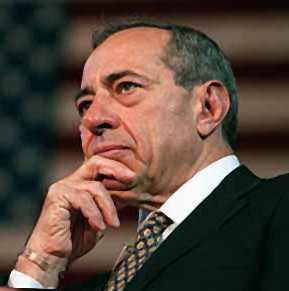 Few speeches in recent American history have so articulately laid out the most basic ideological differences between our two political parties as did Mario Cuomo's keynote address to the 1984 Democratic National Convention. It challenged Ronald Reagan's oft-repeated charcaterization of America as a "shining city on a hill". A brief excerpt from Cuomo:
"President Reagan told us from the very beginning that he believed in a kind of social Darwinism. Survival of the fittest. "Government can't do everything," we were told, so it should settle for taking care of the strong and hope that economic ambition and charity will do the rest. Make the rich richer, and what falls from the table will be enough for the middle class and those who are trying desperately to work their way into the middle class.
You know, the Republicans called it "trickle-down" when Hoover tried it. Now they call it "supply side." But it's the same shining city for those relative few who are lucky enough to live in its good neighborhoods. But for the people who are excluded, for the people who are locked out, all they can do is stare from a distance at that city's glimmering towers.
It's an old story. It's as old as our history. The difference between Democrats and Republicans has always been measured in courage and confidence. The Republicans -- The Republicans believe that the wagon train will not make it to the frontier unless some of the old, some of the young, some of the weak are left behind by the side of the trail. "The strong" -- "The strong," they tell us, "will inherit the land."
We Democrats believe in something else. We democrats believe that we can make it all the way with the whole family intact, and we have more than once. Ever since Franklin Roosevelt lifted himself from his wheelchair to lift this nation from its knees -- wagon train after wagon train -- to new frontiers of education, housing, peace; the whole family aboard, constantly reaching out to extend and enlarge that family; lifting them up into the wagon on the way; blacks and Hispanics, and people of every ethnic group, and native Americans -- all those struggling to build their families and claim some small share of America. For nearly 50 years we carried them all to new levels of comfort, and security, and dignity, even affluence. And remember this, some of us in this room today are here only because this nation had that kind of confidence. And it would be wrong to forget that."
Friday, October 06, 2006
Don't Build This Fence
From the party that idolizes Ronald Reagan, the President that championed the tearing down of the wall between East and West Berlin, promoted free markets and described the United States as a shining city on a hill, the Republican party of today puts up walls, creates barriers between the U.S. and our biggest trading partner, and wastes government resources to appeal to the xenophobic base of their party. A characteristic none should be proud of.
Built under the auspices that such a fence will better protect Americans from further possible terrorist attacks and that it would be tough on illegal immigrants, only time will truly tell how effective a it will be at doing just that. Unless the demand for low-skill, low-wage workers dries up in the United States, this fence will only exacerbate the dangers of crossing the border for people desperate for a new life and opportunities that lie across the border. Without a legal means, that is not so unnecessarily cumbersome and bureaucratic that it discourages people from following the law, immigrants will continue to bear the hardships and dangers of crossing the desert. This policy is as likely to stop the influx of illegal immigration as prohibition stopped the sale of alcohol. This immigration policy represents the antithesis to free market policies that calls for the free flow of information and capital, including human capital. More importantly, this fence is an antithesis to what has made America a beacon of hope, the greatest experiment in Democracy and, of course, a country of immigrants.
Many of my ancestors came to this country on boats, and more recently on my mothers side in a plane, like nearly everybody else who today call themselves Americans. For this generation of Americans born on American soil to say they have more of a right to the freedoms we cherish and the opportunities here than people born south of our border is hypocritical.
The solution to our security and immigration concerns to build a fence is a wholly inappropriate policy and is a another example of this Congress squandering valuable resources by caving in to people's most base fears. It is a blemish on our record of championing freedom and open markets and with time will prove to be a misplaced effort to provide security to our country.
