Darfur, Congo, Rwanda and, before that, Bosnia. It is hard to contemplate man’s capacity for inhumanity without feeling despair and paralysis. The world usually pays attention only after the killing has spun out of control, when ethnic, religious an
d political divides are rubbed so raw that the furies are infinitely harder to calm. By that point, the United States and others are faced with the agonizing choice of either intervening militarily or allowing the killing to go on.
A new report by a task force headed by former Secretary of State Madeleine Albright and former Defense Secretary William Cohen offers some hope, arguing that it is possible to prevent genocide before it spins out of control. It offers practical policy suggestions — what Mrs. Albright calls a “mechanism for looking at genocide in a systematic way” — for the next administration. The report says that early warning and prevention are key and calls on the White House to create a senior-level interagency committee directed by the National Security Council to analyze threats of genocide and mass atrocities around the world and consider appropriate preventive action.
When initial signs of mass atrocities are detected, the task force would also require the intelligence community to do a full policy review and prepare a crisis response plan. The goal is to engage leaders, institutions and civil society in affected communities urgently, and at an early stage when talk and other help may defuse the situation. The task force urges the United States government to spend an additional $250 million annually on crisis prevention and response efforts, with a portion going to help international partners, including the United Nations and regional organizations, build their capacity.
It is hard to generate political will to fix a problem before it has crested. But if there is any doubt about the need for a new policy and structure, consider the Bush administration’s desperate failure in Darfur. Four years after President Bush declared the mass killings there genocide, the horrors continue. As many as 300,000 people have been killed and 2.7 million driven from their homes. With the region increasingly engulfed in interrebel warfare, a political settlement appears to be even further out of reach.
We hope President-elect Barack Obama and his top aides will seriously consider the report’s policy recommendations before they, too, find themselves grappling with such agonizing choices.
Sunday, December 21, 2008
Preventing Genocide


Thursday, October 30, 2008
Justice, Then Peace in Sudan
The Hague - For almost two decades, Sudanese president Omar al-Bashir has waged foul wars on ethnic groups within his country that happened to live on oil- or mineral-rich land. Today, the international community is finally close to holding him accountable. Though it could make for a rocky transition, it is the key to peace. Even before Darfur, aerial bombing, murder, and rape seemed to be his government's tools for settling scores with the mainly African Christians of southern Sudan. In that 23-year war for resource control, just under 2 million people died as a result of mass violence.
In 2005, the US brokered a peace deal that divided control of the oil fields. But it did not address the crimes committed. And by the time it was signed, Mr. Bashir was back to the same, in Darfur. This summer, however, things changed. The chief prosecutor of the International Criminal Court, Luis Moreno-Ocampo, requested an arrest warrant against Bashir on suspicion of genocide. A flood of worst-case predictions followed. A fear that the situation will worsen has increased. And so have worries about chances for any meaningful peace process.
The pressure is now mounting on the United Nations Security Council to defer the ICC proceedings – as soon as this month – before the court judges decide the fate of the warrant request. This political emergency brake was meant to be used only when the interests of justice and peace collide. Bashir is clearly doing his best to convince the world that the call for his arrest will indeed collide with peace in Darfur. He recently sent a diplomatic mission to Security Council member states, promising renewed peace and possible deals. Back home, his troops attacked Darfur's largest refugee camp, killing dozens.
In fact, the most serious threat to peace and security in Sudan is Bashir himself. His regime has the power to make the Darfurians' life worse yet. It can also endanger international peacekeepers and humanitarian workers, upset the fragile peace in the south, and continue to destabilize its neighbor, Chad. In the past, Khartoum has often used its power in unsettling ways – and many believe that it would not hesitate to do it again.
But is pursuing the course of justice the right answer to this threat? Within the Security Council, divisions run deep on that question. About half of member states support a deferral, and many others still sit carefully on the fence. In order to credibly pull the brake on justice, the Security Council would have to promptly ensure real peace in Darfur, including a military force strong enough to back it up. Such a deal would have to offer the victims immediate security and relief. It would need to tackle the division of power and natural resources in order to create sustainable peace. And this time it would also have to address past crimes and guarantee that the country's rulers won't resort to genocide again.
It is doubtful whether Bashir would be ready to accept such terms. But anything less ambitious would undermine not only the ICC, but also the credibility of the member states that would allow it. A better option is to simply let the ICC do its job – while ensuring that the innocent in Darfur do not suffer the consequences of the regime's reaction to such a principled stand.
As the third sitting head of state to be suspected or indicted for war crimes, Bashir is the real watershed in the history of international justice. Allowing the court to decide on the issue of his criminal responsibility would mean that the two previous cases – Serbian President Slobodan Milosevic and Liberia's President Charles Taylor – were not oddities, but part of a genuine paradigm shift. It would make international justice a player and introduce new checks and balances into the unruly world of international relations. Equally important, this shift would send a clear message that genocide has become unforgivable.
There might also be some real political benefits in letting justice run its course. An international arrest warrant could erode Bashir's authority at home and abroad and speed up his political demise. The war crimes indictment surely hastened Mr. Milosevic's fall from power: It made him useless as an international negotiator. There is obviously no guarantee that in the case of Bashir the consequences would be as quick and beneficial. Sudan is a large, oil-rich state with needy and influential friends. But an arrest warrant would surely make some of his allies wonder about the wisdom of doing business with a fugitive.
And, yes, the prospect of an eventual change at the top of such a volatile country may seem unsettling. But the only stability under Bashir that Sudan has known is the one of repression, recurring armed conflict, and mass murder. The Sudanese president may have been moderately cooperative on the war on terror, but the price has been allowing him to terrorize others. His country and the millions of its war-tired citizens deserve a different future. And the US deserves a better ally.


Friday, February 15, 2008
In the News: Africa
As the NY Times reports: “On the eve of a planned trip to Africa, President Bush thrust himself into the role of peacemaker on Thursday, as his plans to promote American efforts against poverty and disease gave way to a more pressing imperative: addressing the violence and turmoil on the continent.” As a self-proclaimed peace-maker, the President also defended his decision not to send troops to Darfur (despite what he calls a genocide taking place) as a "seminal decision" not to intervene with force, taken partly out of the desire not to send US troops into another Muslim country.
Elsewhere on the continent, Kenya's political rivals agreed to an independent review of the disputed presidential election (to be released within three to six months). As the BBC reports: “The agreement, which also calls for a new constitution, is a clear sign of progress after weeks of violence that have left more than 1,000 people dead.”
Meanwhile, Chadian President Deby declared a nationwide state of emergency, telling citizens that tightened controls are ''measures important and urgent to maintain order, guarantee stability and assure the good functioning of the state.'' NY Times: The Red Cross said more than 160 people were killed and 1,000 wounded in the fighting, which reached the edge of the presidential palace before the rebels were driven out of N'Djamena and back toward Chad's eastern border with Sudan.
Monday, February 04, 2008
Africa on Fire

This weekend, “after a three-day advance across the desert, hundreds of rebels fought their way into the capital of the oil-rich nation of Chad.”
The government of Chad, a former French colony with a population of almost 10 million and a newly booming oil industry, has in recent years battled a variety of rebel groups along its volatile eastern border with Sudan, forcing an estimated 170,000 Chadians to flee their homes for sprawling camps in the scrubby desert.While tonight, Chadian President Idriss Déby, the “cowboy of the sands”, appears to have the upper-hand in the conflict, the outcome is far from certain. Regardless, its implications will undoubtedly have international implications, spreading beyond Chad and likely fanning the flames of the violence in Darfur.
As reported, “Some 3700 EU soldiers are on alert for immediate deployment along Chad's eastern border with Sudan under a UN mandate to protect hundreds of thousands of refugees from Darfur. Advance units were meant to begin deploying last week, but the mission's Irish commander, Lieutenant-General Pat Nash, said the operation is on hold until the security situation becomes clearer.”
If (Déby) survives, he will emerge stronger, the crisis emphasising his importance to western strategy in containing the Darfur conflict across the border in Sudan… But if Mr Déby falls, the conflict in Darfur could worsen, plans to deploy European Union troops in Chad may stall, and turmoil could spill into Central African Republic, potentially destabilising a swathe of Africa.A victory for Bashir, one of the world’s worst war criminals, is the last thing we need, given the ongoing futility of our efforts in Darfur.
Although he was originally installed with Khartoum’s help in 1990, his support for Darfur rebels from his Zaghawa community has angered his former friends. Observers say the Sudanese government has adopted Chadian rebels in the hope of ousting Mr Déby and cutting supply lines to fractious insurgents in Darfur... The real winner if Mr Déby falls would be President Omar Hassan al-Bashir’s Islamist government in Sudan, who might feel encouraged to try to smash the Darfur rebels and even challenge Mr Déby’s allies in CAR (Central African Republic).
There has been no shortage of outrage in the Western democracies over the genocidal repression of Darfur's African population. Effective action to force Sudan to stop it, however, has been harder to come by. The latest illustration of the gap between rhetoric and action is the proposed joint United Nations-African Union peacekeeping force, which was supposed to be up and running with 26,000 soldiers by Jan. 1 - but isn't. In fact, only about 9,000 poorly trained and equipped soldiers are on the ground, most of them African Union troops left over from a previous, ineffectual force sponsored by that organization...And while the fires burn in central Africa, the New York Times highlights the turmoil in Kenya.
Through administrative harassment and diplomatic obstruction, Sudan's government has thwarted the deployment of other forces, including those from more substantial Scandinavian and Asian militaries. The danger is compounded by the splintering of Darfur's rebel groups, which has made it more difficult to bring all the parties into peace talks.
It is far too easy to become inured to bad news from Africa, a continent of great promise and peril. Kenya’s rampage of ethnically driven killings that is now five weeks long is especially sickening and attention-grabbing because of how much hope the world had for Kenya’s democracy and economic revival - and how fast the country has descended into madness...The United States lack of an Africa policy is compounded by the precarious situation our military is confronting by being overstretched and under-equipped in Iraq. Putting a substantial number of American troops on the ground in Africa may never be practical or politically acceptable in Washington, especially in the aftermath of Somalia. But without the ability to leverage that sword over the head of the Bashirs of the world, we can only expect more of the same.
The vicious tribal violence - condemned by one American official this week as “ethnic cleansing” - has spread with stunning speed since late December when Kenya’s electoral commission hastily handed a second term to President Mwai Kibaki, despite independent reports of glaring voting irregularities. The toll is now more than 800 Kenyans dead, 70,000 driven from their homes and thousands more fled to neighboring countries. The economy is paralyzed.
Instead of trying to calm their supporters and negotiate a political solution, Mr. Kibaki and his principal challenger, Raila Odinga, have called for peace, and then incited more killing, accusing each other of orchestrating the mayhem. For too long, both men have succumbed to their baser ambitions and resisted high-level mediation...
Sustained and robust international efforts are needed to persuade the Kenyan rivals to do the right thing. We are encouraged that United Nations Secretary General Ban Ki-moon decided to personally intervene and that his chief mediator, Kofi Annan, the former secretary general, was able to announce on Friday an agreement on a framework for talks that could resolve the crisis. Major countries, including the United States, which provides Kenya with more than $600 million in aid per year, need to bring a lot more pressure on both Mr. Kibaki and Mr. Odinga to ensure that that happens. If reason can’t persuade them to reconcile, then sanctions and a suspension of nonhumanitarian assistance must be seriously considered.
Friday, February 01, 2008
The Lessons of Darfur
"The campaign to save Darfur is alive, but it is no longer kicking. You could say that it has achieved all its stated goals: public awareness, international pressure, congressional action, the administration's involvement. Well, all but one: The crisis in Darfur is not yet solved, and the campaign to save Darfur is running out of options."
"So, here's the problem of the campaign to save Darfur: Public interest has waned, the simple options have all been exhausted, the political machinery is mired in the election process, and other problems - Pakistan, Iran - have taken over the front pages.""This story provides many valuable lessons, but we shouldn't forget the most elusive: The good people of America who wanted and still want to save the miserable people of Darfur expect too much of their government. And many of their desires are contradictory - almost impossible to achieve. Darfur illustrates these contradictions nicely."
"Americans who want to help the persecuted people of Darfur want U.S. policy to be righteous, but they also prefer a government that doesn't pursue its goals too aggressively. They want the U.S. government to cooperate with the international community but also to be effective. They want America to be the policeman of the world, but in most cases, they are willing to support it only when it acts like a social worker."
Friday, January 25, 2008
Darfur's Best Hope
The United States and its allies on Darfur have long responded to Khartoum's obstructions with public complaints and reaffirmations of their commitment to the mission. Though well-intentioned, this approach has played into the (National Congress Party) NCP's hands. While American attention has been narrowly focused on the struggling peacekeeping mission, the NCP has been undercutting a potentially dramatic challenge to its rule - and with it, the greatest opportunity for lasting peace in Darfur. With the swearing in this month of a new special envoy for Sudan, Rich Williamson, it is time that America revisits its approach to Sudan – and recognizes that the peacekeeping mission should not be its exclusive focus.
As Mr. Bashir's latest provocation suggests, the problem in Darfur is one that ultimately cannot be resolved by peacekeepers. That's because its roots don't lie in local grievances or ethnic divisions – though both have fueled the fighting – but in the halls of power in Khartoum. The peacekeeping mission is urgently needed to improve immediate security, but lasting peace will come to Darfur and the rest of Sudan only when the country is led by a government genuinely committed to the cause. Remove the NCP from power and, as a senior UN official in Sudan told me recently, "the
problem in Darfur is over."
In most misgoverned nations, talk of such regime change would seem little more than a pipe dream – but remarkably, improbably, there exists in Sudan today a chance of revolution through the ballot box. Under the terms of an existing but neglected peace agreement, signed in 2005 to end the 21-year civil war between the Khartoum government and southern rebels, Sudan is obligated to hold a national election by July 2009. This peace deal, known as the Comprehensive Peace Agreement (CPA), also promised the south a referendum on independence in 2011. Next year's election is essentially the last chance to stave off what will otherwise be a resounding vote for southern secession, by showing southerners that they will be allowed to compete for national power in a unified, democratic Sudan…
To be sure, it is hard to be optimistic that Bashir will ever permit an election that threatens his grip on power. But any vote, however flawed, will challenge the entrenched political order and give the opposition a chance to organize. Its conduct also represents the only scenario through which Sudan might survive as a unified state past the south's likely secession vote in 2011. And despite provocations such as this latest appointment, recent history shows that even the NCP can be influenced by a sustained campaign of targeted international pressure: Recall its eventual acquiescence to the UN peacekeeping mission.With its current focus on peacekeepers, the Bush administration risks allowing this critical election to become just another broken NCP promise. The peacekeeping mission in Darfur is surely important, but if the US wants to see long-term peace in Sudan, the new special envoy must place greater emphasis on the implementation of the CPA and the conduct of a free, fair, and potentially regime-shattering election next year.
Wednesday, January 23, 2008
Then Came Darfur
 As a recent PBS Frontline program opens - "The world vowed "never again" after the genocide in Rwanda and the atrocities in Srebrenica, Bosnia. Then came Darfur."
As the LA Times reports, with an upcoming trip to Sudan later this month by UN Secretary-General Ban Ki-moon, Sudanese President Bashir signaled his disrespect for the institution and its intentions with a political shot across the bow.
It's a bleak day for humanity when one of the architects of the genocide in Darfur gets a promotion. In a gesture of supreme defiance of decency and international law, the Sudanese government announced Monday that it had appointed Musa Hilal, a militia leader who recruited and mobilized the janjaweed militias responsible for the carnage in Darfur, to be a special advisor to the president on ethnic affairs. It gets worse. Hilal is the third alleged war criminal to be elevated to a government post. He is under United Nations and U.S. State Department sanctions; the other two have been indicted by the International Criminal Court.If there was a time for the UN to live up to its charter - to save succeeding generations from the scourge of war and to reaffirm faith in fundamental human rights - it is now. The atrocities being committed by Bashir and the janjaweed have been labeled genocide since 2004 by the US government yet President Bush and the UN remain slow to act. It's time for some backbone and it's time to do whatever it takes to get China (who has frequently prevented strong action on Sudan because of trade ties) on board. Multilateral sanctions against those responsible are a nice slap on the wrist but it's time we stop negotiating with a war criminal, do whatever it takes to alleviate the current cycle of genocide, and ensure the prompt prosecution of the Bashir thugs in an international court of justice.
In an especially cynical move, one of the indicted has been put in charge of humanitarian aid to Darfur. Sudan also has been doing everything possible to obstruct the deployment of U.N. peacekeepers, including shooting at a clearly marked U.N. convoy this month. Appeasement and negotiation from a position of weakness have not and will not stop the thuggery of the oil-rich Sudanese regime. Only muscle will do. But the "civilized" world has done next to nothing to enforce meaningful economic sanctions, hasn't even moved to arrest the indicted war criminals and, disgracefully, has yet to provide even one of the helicopters that U.N. peacekeepers need. It's time to face facts: Unless the U.N. gets far more political, economic and military support from its posturing but so-far feckless members, it may as well pack up its blue helmets and go home.
Friday, December 01, 2006
Blind Intolerance
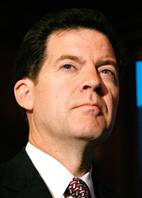 As we all know far too well, Sam Brownback has the well-earned reputation of being the voice of the religious right in the United States Senate. While some of his views clearly align him on the side of compassion and justice (particularly his efforts to end the genocide in Darfur and to address the crisis in Northern Uganda), his religious fervor has also placed him repeatedly on the side of moral self-righteousness and intolerance. As an influential member of the Senate Judiciary Committee, he is in a position to publicly inject these views throughout the confirmation process of countless federal judicial nominations.
Most recently, he has taken the audacious step of placing a procedural “hold” on the nomination of Michigan Court of Appeals Judge Janet T. Neff to be a U.S. District Court judge. It’s not because of her qualifications or her record as a judge. No, it’s because she attended a lesbian commitment ceremony for her neighbor of 20 years…a legally non-binding ceremony conducted by a minister in Massachusetts.
And why would a judicial nominee place her confirmation in jeopardy by doing something like that? After all, it surely wasn’t the supportive act of a friend during an important event in her life. More so, it was probably a definitive statement of her judicial philosophy on the issue of legalizing same-sex marriage. "It seems to speak about her view of judicial activism," says an incredulous Brownback.
It constantly amazes me that the groups and individuals whose religious views are most intertwined with their lives and their ideologies do not practive more tolerance. Somehow they fail realize that every effort they undertake today to discriminate, condemn, and persecute others simply because of who they are, makes it more and more inevitable that they will find themselves on the receiving end of that intolerance tomorrow.
Wednesday, November 01, 2006
Darfur, no good options

The promise made at the end of WWII to prevent all future genocide rings hollow now. The ongoing situation in the Darfur region of Sudan is abhorrent; up to 450,000 people murdered and 2 million displaced. The genocide of non-Arabs being perpetrated by the Janjaweed militia and supported by the Sudanese government is already compared to other recent genocides in Rwanda and Bosnia.
Despite the numerous speeches and resolutions defining the atrocious events in Darfur as genocide and condemning the actions of the Sudanese government, world leaders have yet to determine how best to confront genocide or even shown a willingness to do so. It is not because of a lack of compassion, but instead, a lack of preparation. In entries to come, I will explain my take on the situation, why world leader are left with no good options to halt the killings taking place in Darfur and what changes people should demand if they feel, as I do, that there is a moral obligation to intervene in such dire situations.
